Search Editorial Photos
"only source"
596 professional editorial images found
#13068902
7 December 2025
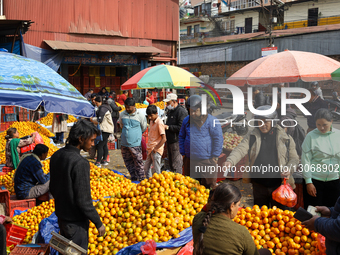
People purchase oranges from a wholesale market in Kathmandu, Nepal, on December 7, 2025. With the onset of cooler months, Nepal's markets brim with oranges as it is the season for the country's national fruit. Known for its juicy segments and vibrant orange peel, this citrus favorite not only fuels the economy but also provides substantial health benefits. Oranges, part of the citrus family, are Nepal's most cultivated fruit. With production exceeding 185,000 tons annually, oranges are farmed on nearly 27,892 hectares across 48 districts. The National Agriculture Census shows oranges as the second most widely grown fruit after mangoes, making them a staple crop and key revenue source for farmers in the hill regions.
Restricted to Editorial Use Only.
Commercial use is not permitted without prior authorization.
Please contact us for more information.
#13068903
7 December 2025
People purchase oranges from a wholesale market in Kathmandu, Nepal, on December 7, 2025. With the onset of cooler months, Nepal's markets brim with oranges as it is the season for the country's national fruit. Known for its juicy segments and vibrant orange peel, this citrus favorite not only fuels the economy but also provides substantial health benefits. Oranges, part of the citrus family, are Nepal's most cultivated fruit. With production exceeding 185,000 tons annually, oranges are farmed on nearly 27,892 hectares across 48 districts. The National Agriculture Census shows oranges as the second most widely grown fruit after mangoes, making them a staple crop and key revenue source for farmers in the hill regions.
Restricted to Editorial Use Only.
Commercial use is not permitted without prior authorization.
Please contact us for more information.
#13068904
7 December 2025
People purchase oranges from a wholesale market in Kathmandu, Nepal, on December 7, 2025. With the onset of cooler months, Nepal's markets brim with oranges as it is the season for the country's national fruit. Known for its juicy segments and vibrant orange peel, this citrus favorite not only fuels the economy but also provides substantial health benefits. Oranges, part of the citrus family, are Nepal's most cultivated fruit. With production exceeding 185,000 tons annually, oranges are farmed on nearly 27,892 hectares across 48 districts. The National Agriculture Census shows oranges as the second most widely grown fruit after mangoes, making them a staple crop and key revenue source for farmers in the hill regions.
Restricted to Editorial Use Only.
Commercial use is not permitted without prior authorization.
Please contact us for more information.
#13068905
7 December 2025
People purchase oranges from a wholesale market in Kathmandu, Nepal, on December 7, 2025. With the onset of cooler months, Nepal's markets brim with oranges as it is the season for the country's national fruit. Known for its juicy segments and vibrant orange peel, this citrus favorite not only fuels the economy but also provides substantial health benefits. Oranges, part of the citrus family, are Nepal's most cultivated fruit. With production exceeding 185,000 tons annually, oranges are farmed on nearly 27,892 hectares across 48 districts. The National Agriculture Census shows oranges as the second most widely grown fruit after mangoes, making them a staple crop and key revenue source for farmers in the hill regions.
Restricted to Editorial Use Only.
Commercial use is not permitted without prior authorization.
Please contact us for more information.
#13068906
7 December 2025
People purchase oranges from a wholesale market in Kathmandu, Nepal, on December 7, 2025. With the onset of cooler months, Nepal's markets brim with oranges as it is the season for the country's national fruit. Known for its juicy segments and vibrant orange peel, this citrus favorite not only fuels the economy but also provides substantial health benefits. Oranges, part of the citrus family, are Nepal's most cultivated fruit. With production exceeding 185,000 tons annually, oranges are farmed on nearly 27,892 hectares across 48 districts. The National Agriculture Census shows oranges as the second most widely grown fruit after mangoes, making them a staple crop and key revenue source for farmers in the hill regions.
Restricted to Editorial Use Only.
Commercial use is not permitted without prior authorization.
Please contact us for more information.
#13068907
7 December 2025
A Nepali vendor arranges oranges at a wholesale market in Kathmandu, Nepal, on December 7, 2025. With the onset of cooler months, Nepal's markets brim with oranges as the season for the country's national fruit. Known for its juicy segments and vibrant orange peel, this citrus favorite not only fuels the economy but also provides substantial health benefits. Oranges, part of the citrus family, are Nepal's most cultivated fruit. With production exceeding 185,000 tons annually, oranges are farmed on nearly 27,892 hectares across 48 districts. The National Agriculture Census shows oranges as the second most widely grown fruit after mangoes, making them a staple crop and key revenue source for farmers in the hill regions.
Restricted to Editorial Use Only.
Commercial use is not permitted without prior authorization.
Please contact us for more information.
#13068908
7 December 2025
A Nepali vendor arranges oranges at a wholesale market in Kathmandu, Nepal, on December 7, 2025. With the onset of cooler months, Nepal's markets brim with oranges as the season for the country's national fruit. Known for its juicy segments and vibrant orange peel, this citrus favorite not only fuels the economy but also provides substantial health benefits. Oranges, part of the citrus family, are Nepal's most cultivated fruit. With production exceeding 185,000 tons annually, oranges are farmed on nearly 27,892 hectares across 48 districts. The National Agriculture Census shows oranges as the second most widely grown fruit after mangoes, making them a staple crop and key revenue source for farmers in the hill regions.
Restricted to Editorial Use Only.
Commercial use is not permitted without prior authorization.
Please contact us for more information.
#13068909
7 December 2025
Oranges are pictured at a wholesale market in Kathmandu, Nepal, on December 7, 2025. With the onset of cooler months, Nepal's markets brim with oranges as the season for the country's national fruit. Known for its juicy segments and vibrant orange peel, this citrus favorite not only fuels the economy but also provides substantial health benefits. Oranges, part of the citrus family, are Nepal's most cultivated fruit. With production exceeding 185,000 tons annually, oranges are farmed on nearly 27,892 hectares across 48 districts. The National Agriculture Census shows oranges as the second most widely grown fruit after mangoes, making them a staple crop and key revenue source for farmers in the hill regions.
Restricted to Editorial Use Only.
Commercial use is not permitted without prior authorization.
Please contact us for more information.
#13068910
7 December 2025
A Nepali vendor arranges oranges at a wholesale market in Kathmandu, Nepal, on December 7, 2025. With the onset of cooler months, Nepal's markets brim with oranges as the season for the country's national fruit. Known for its juicy segments and vibrant orange peel, this citrus favorite not only fuels the economy but also provides substantial health benefits. Oranges, part of the citrus family, are Nepal's most cultivated fruit. With production exceeding 185,000 tons annually, oranges are farmed on nearly 27,892 hectares across 48 districts. The National Agriculture Census shows oranges as the second most widely grown fruit after mangoes, making them a staple crop and key revenue source for farmers in the hill regions.
Restricted to Editorial Use Only.
Commercial use is not permitted without prior authorization.
Please contact us for more information.
#13068911
7 December 2025
A Nepali vendor shows oranges to the customer to ensure the quality at a wholesale market in Kathmandu, Nepal, on December 7, 2025. With the onset of cooler months, Nepal's markets brim with oranges as the season for the country's national fruit. Known for its juicy segments and vibrant orange peel, this citrus favorite not only fuels the economy but also provides substantial health benefits. Oranges, part of the citrus family, are Nepal's most cultivated fruit. With production exceeding 185,000 tons annually, oranges are farmed on nearly 27,892 hectares across 48 districts. The National Agriculture Census shows oranges as the second most widely grown fruit after mangoes, making them a staple crop and key revenue source for farmers in the hill regions.
Restricted to Editorial Use Only.
Commercial use is not permitted without prior authorization.
Please contact us for more information.
#13068912
7 December 2025
People purchase oranges from a wholesale market in Kathmandu, Nepal, on December 7, 2025. With the onset of cooler months, Nepal's markets brim with oranges as it is the season for the country's national fruit. Known for its juicy segments and vibrant orange peel, this citrus favorite not only fuels the economy but also provides substantial health benefits. Oranges, part of the citrus family, are Nepal's most cultivated fruit. With production exceeding 185,000 tons annually, oranges are farmed on nearly 27,892 hectares across 48 districts. The National Agriculture Census shows oranges as the second most widely grown fruit after mangoes, making them a staple crop and key revenue source for farmers in the hill regions.
Restricted to Editorial Use Only.
Commercial use is not permitted without prior authorization.
Please contact us for more information.
#13068913
7 December 2025
Oranges are pictured at a wholesale market in Kathmandu, Nepal, on December 7, 2025. With the onset of cooler months, Nepal's markets brim with oranges as the season for the country's national fruit. Known for its juicy segments and vibrant orange peel, this citrus favorite not only fuels the economy but also provides substantial health benefits. Oranges, part of the citrus family, are Nepal's most cultivated fruit. With production exceeding 185,000 tons annually, oranges are farmed on nearly 27,892 hectares across 48 districts. The National Agriculture Census shows oranges as the second most widely grown fruit after mangoes, making them a staple crop and key revenue source for farmers in the hill regions.
Restricted to Editorial Use Only.
Commercial use is not permitted without prior authorization.
Please contact us for more information.
#13068914
7 December 2025
A Nepali consumer purchases an orange from a wholesale market in Kathmandu, Nepal, on December 7, 2025. With the onset of cooler months, Nepal's markets brim with oranges as it is the season for the country's national fruit. Known for its juicy segments and vibrant orange peel, this citrus favorite not only fuels the economy but also provides substantial health benefits. Oranges, part of the citrus family, are Nepal's most cultivated fruit. With production exceeding 185,000 tons annually, oranges are farmed on nearly 27,892 hectares across 48 districts. The National Agriculture Census shows oranges as the second most widely grown fruit after mangoes, making them a staple crop and key revenue source for farmers in the hill regions.
Restricted to Editorial Use Only.
Commercial use is not permitted without prior authorization.
Please contact us for more information.
Drought Hits Madhesh Province Of Nepal Mid-monsoon, Government Declares Disaster Crisis Zone
24 July 2025
#12580930
24 July 2025
Residents of Birgunj Metropolitan City in Parsa District of Madhesh Province, Nepal, fetch water from a tanker mobilized by local authorities as drought in mid-monsoon dries out water sources on July 24, 2025. An emergency cabinet meeting on July 23, 2025, declares Nepal's Madhesh Province a disaster crisis zone as severe drought hits the nation's breadbasket. The unusual absence of rain in the Southern plains of Nepal in mid-monsoon pushes the region into a state of crisis. The government makes the declaration under Sub-section 1 of Section 32 of the Disaster Risk Reduction and Management Act, 2017. Due to acute water shortages, farmers are unable to transplant paddy. The drought leaves seedbeds dry, and paddy saplings wither, sparking fears of an impending food shortage in Nepal's major rice-producing region. The scarcity of water during mid-monsoon in the Tarai, Nepal's food basket, threatens not only farmers' livelihoods but also the national economy.
Restricted to Editorial Use Only.
Commercial use is not permitted without prior authorization.
Please contact us for more information.
Drought Hits Madhesh Province Of Nepal Mid-monsoon, Government Declares Disaster Crisis Zone
24 July 2025
#12580931
24 July 2025
A girl guards the buckets and containers as they wait for tankers to fetch water in Birgunj Metropolitan City, Parsa District, Madhesh Province, Nepal, on July 24, 2025. An emergency cabinet meeting on July 23, 2025, declares Nepal's Madhesh Province a disaster crisis zone as severe drought hits the nation's breadbasket. The unusual absence of rain in the Southern plains of Nepal in mid-monsoon pushes the region into a state of crisis. The government makes the declaration under Sub-section 1 of Section 32 of the Disaster Risk Reduction and Management Act, 2017. Due to acute water shortages, farmers are unable to transplant paddy. The drought leaves seedbeds dry, and paddy saplings wither, sparking fears of an impending food shortage in Nepal's major rice-producing region. The scarcity of water during mid-monsoon in the Tarai, Nepal's food basket, threatens not only farmers' livelihoods but also the national economy.
Restricted to Editorial Use Only.
Commercial use is not permitted without prior authorization.
Please contact us for more information.
#12429742
31 May 2025
This Floating Market Is Located In Banarupa Bazar In Kaptai Lake, Rangamati, on may 31, 2025. It Is Known As Samata Ghat. Not Only Seasonal Fruits, But Also All The Products Produced In The Mountains, Including The Daily Necessities Of The Hill Dwellers, Are Available In This Floating Market. Mainly The Aboriginal People From Hilly Region Visit The Market Twice A Week. Rows Of Floating Boats Sway Along The Banks Of The Ghat To The Rhythm Of The Waves.
Restricted to Editorial Use Only.
Commercial use is not permitted without prior authorization.
Please contact us for more information.