Search Editorial Photos
"platform layout"
186 professional editorial images found
#13420574
8 March 2026
The interior of a first-class open-plan coach with a 2+1 seating layout is seen aboard PKP Intercity Express InterCity train EIC 1400, which runs between Warsaw and Katowice, in Poland, on February 21, 2026.
Restricted to Editorial Use Only.
Commercial use is not permitted without prior authorization.
Please contact us for more information.
#13420576
8 March 2026
The interior of a first-class open-plan coach with a 2+1 seating layout is seen aboard PKP Intercity Express InterCity train EIC 1400, which runs between Warsaw and Katowice, in Poland, on February 21, 2026.
Restricted to Editorial Use Only.
Commercial use is not permitted without prior authorization.
Please contact us for more information.
#13420689
8 March 2026
The interior of a first-class open-plan coach with a 2+1 seating layout is seen aboard PKP Intercity Express InterCity train EIC 1400, which runs between Warsaw and Katowice, in Poland, on February 21, 2026.
Restricted to Editorial Use Only.
Commercial use is not permitted without prior authorization.
Please contact us for more information.
#13420691
8 March 2026
The interior of a first-class open-plan coach with a 2+1 seating layout is seen aboard PKP Intercity Express InterCity train EIC 1400, which runs between Warsaw and Katowice, in Poland, on February 21, 2026.
Restricted to Editorial Use Only.
Commercial use is not permitted without prior authorization.
Please contact us for more information.
#13304676
11 February 2026
Professor Robin Coningham, UNESCO Chair on Archaeological Ethics and Practice in Cultural Heritage at Durham University and co-director of the excavations, attends a press conference in Kathmandu, Nepal, on February 11, 2026. A collaborative team of national and international experts from the Department of Archaeology, Government of Nepal, Lumbini Development Trust, and Durham University's UNESCO Chair uncovers Nepal's first example of an apsidal Buddhist temple within the ancient city of Tilaurakot-Kapilavastu, one of the best-preserved Early Historic cities and hinterlands in South Asia. A clear category of temple in South Asia, they are called apsidal as they have a curved end wall that defines the religious focus of the monument, with an entrance platform at the other end. The earliest known examples are cut into rock, with later monuments constructed out of stone, timber, or brick. The monument revealed at Tilaurakot-Kapilavastu, the first discovered in Nepal, follows this exact layout but is unusual in its location. It is a rare example of an apsidal temple constructed within a city rather than in a separate religious complex. The newly discovered apsidal structure is built near the center of the city of Tilaurakot-Kapilavastu over the remains of the city's earlier palatial complex. This central walled complex defines an area of 100 by 100 meters through a massive brick wall measuring 1.5 meters wide. After its abandonment, the complex becomes a focus for veneration, with Buddhist monasteries built over its ruined monumental walls. It is within the courtyard of one of these monasteries that the apsidal temple is built, enshrining and respecting an earlier Buddhist stupa within the earlier monastery.
Restricted to Editorial Use Only.
Commercial use is not permitted without prior authorization.
Please contact us for more information.
#13304677
11 February 2026
Archaeologists from the Department of Archaeology, Government of Nepal, Lumbini Development Trust, and Durham University hold a press conference in Kathmandu, Nepal, on February 11, 2026, announcing the uncovering of the first apsidal Buddhist temple in Nepal. A collaborative team of national and international experts from the Department of Archaeology, Government of Nepal, Lumbini Development Trust, and Durham University's UNESCO Chair uncover Nepal's first example of an apsidal Buddhist temple within the ancient city of Tilaurakot-Kapilavastu, one of the best-preserved Early Historic cities and hinterlands in South Asia. A clear category of temple in South Asia, they are called apsidal as they have a curved end wall that defines the religious focus of the monument, with an entrance platform at the other end. The earliest known examples are cut into rock, with later monuments constructed out of stone, timber, or brick. The monument revealed at Tilaurakot-Kapilavastu, the first discovered in Nepal, follows this exact layout but is unusual in its location. It is a rare example of an apsidal temple constructed within a city rather than in a separate religious complex. The newly discovered apsidal structure is built near the center of the city of Tilaurakot-Kapilavastu over the remains of the city's earlier palatial complex. This central walled complex defines an area of 100 by 100 meters through a massive brick wall measuring 1.5 meters wide. After its abandonment, the complex becomes a focus for veneration, with Buddhist monasteries built over its ruined monumental walls. It is within the courtyard of one of these monasteries that the apsidal temple is built, enshrining and respecting an earlier Buddhist stupa within the earlier monastery.
Restricted to Editorial Use Only.
Commercial use is not permitted without prior authorization.
Please contact us for more information.
#13304678
11 February 2026
Professor Robin Coningham, UNESCO Chair on Archaeological Ethics and Practice in Cultural Heritage at Durham University and co-director of the excavations, attends a press conference in Kathmandu, Nepal, on February 11, 2026. A collaborative team of national and international experts from the Department of Archaeology, Government of Nepal, Lumbini Development Trust, and Durham University's UNESCO Chair uncovers Nepal's first example of an apsidal Buddhist temple within the ancient city of Tilaurakot-Kapilavastu, one of the best-preserved Early Historic cities and hinterlands in South Asia. A clear category of temple in South Asia, they are called apsidal as they have a curved end wall that defines the religious focus of the monument, with an entrance platform at the other end. The earliest known examples are cut into rock, with later monuments constructed out of stone, timber, or brick. The monument revealed at Tilaurakot-Kapilavastu, the first discovered in Nepal, follows this exact layout but is unusual in its location. It is a rare example of an apsidal temple constructed within a city rather than in a separate religious complex. The newly discovered apsidal structure is built near the center of the city of Tilaurakot-Kapilavastu over the remains of the city's earlier palatial complex. This central walled complex defines an area of 100 by 100 meters through a massive brick wall measuring 1.5 meters wide. After its abandonment, the complex becomes a focus for veneration, with Buddhist monasteries built over its ruined monumental walls. It is within the courtyard of one of these monasteries that the apsidal temple is built, enshrining and respecting an earlier Buddhist stupa within the earlier monastery.
Restricted to Editorial Use Only.
Commercial use is not permitted without prior authorization.
Please contact us for more information.
#13304679
11 February 2026
Professor Robin Coningham, UNESCO Chair on Archaeological Ethics and Practice in Cultural Heritage at Durham University and co-director of the excavations, briefs about the findings during a press conference in Kathmandu, Nepal, on February 11, 2026. A collaborative team of national and international experts from the Department of Archaeology, Government of Nepal, Lumbini Development Trust, and Durham University's UNESCO Chair uncovers Nepal's first example of an apsidal Buddhist temple within the ancient city of Tilaurakot-Kapilavastu, one of the best-preserved Early Historic cities and hinterlands in South Asia. A clear category of temple in South Asia, they are called apsidal as they have a curved end wall that defines the religious focus of the monument, with an entrance platform at the other end. The earliest known examples are cut into rock, with later monuments constructed out of stone, timber, or brick. The monument revealed at Tilaurakot-Kapilavastu, the first discovered in Nepal, follows this exact layout but is unusual in its location. It is a rare example of an apsidal temple constructed within a city rather than in a separate religious complex. The newly discovered apsidal structure is built near the center of the city of Tilaurakot-Kapilavastu over the remains of the city's earlier palatial complex. This central walled complex defines an area of 100 by 100 meters through a massive brick wall measuring 1.5 meters wide. After its abandonment, the complex becomes a focus for veneration, with Buddhist monasteries built over its ruined monumental walls. It is within the courtyard of one of these monasteries that the apsidal temple is built, enshrining and respecting an earlier Buddhist stupa within the earlier monastery.
Restricted to Editorial Use Only.
Commercial use is not permitted without prior authorization.
Please contact us for more information.
#13304680
11 February 2026
Professor Robin Coningham, UNESCO Chair on Archaeological Ethics and Practice in Cultural Heritage at Durham University and co-director of the excavations, briefs about the findings during a press conference in Kathmandu, Nepal, on February 11, 2026. A collaborative team of national and international experts from the Department of Archaeology, Government of Nepal, Lumbini Development Trust, and Durham University's UNESCO Chair uncovers Nepal's first example of an apsidal Buddhist temple within the ancient city of Tilaurakot-Kapilavastu, one of the best-preserved Early Historic cities and hinterlands in South Asia. A clear category of temple in South Asia, they are called apsidal as they have a curved end wall that defines the religious focus of the monument, with an entrance platform at the other end. The earliest known examples are cut into rock, with later monuments constructed out of stone, timber, or brick. The monument revealed at Tilaurakot-Kapilavastu, the first discovered in Nepal, follows this exact layout but is unusual in its location. It is a rare example of an apsidal temple constructed within a city rather than in a separate religious complex. The newly discovered apsidal structure is built near the center of the city of Tilaurakot-Kapilavastu over the remains of the city's earlier palatial complex. This central walled complex defines an area of 100 by 100 meters through a massive brick wall measuring 1.5 meters wide. After its abandonment, the complex becomes a focus for veneration, with Buddhist monasteries built over its ruined monumental walls. It is within the courtyard of one of these monasteries that the apsidal temple is built, enshrining and respecting an earlier Buddhist stupa within the earlier monastery.
Restricted to Editorial Use Only.
Commercial use is not permitted without prior authorization.
Please contact us for more information.
#13304681
11 February 2026
Professor Robin Coningham, UNESCO Chair on Archaeological Ethics and Practice in Cultural Heritage at Durham University and co-director of the excavations, briefs about the findings during a press conference in Kathmandu, Nepal, on February 11, 2026. A collaborative team of national and international experts from the Department of Archaeology, Government of Nepal, Lumbini Development Trust, and Durham University's UNESCO Chair uncovers Nepal's first example of an apsidal Buddhist temple within the ancient city of Tilaurakot-Kapilavastu, one of the best-preserved Early Historic cities and hinterlands in South Asia. A clear category of temple in South Asia, they are called apsidal as they have a curved end wall that defines the religious focus of the monument, with an entrance platform at the other end. The earliest known examples are cut into rock, with later monuments constructed out of stone, timber, or brick. The monument revealed at Tilaurakot-Kapilavastu, the first discovered in Nepal, follows this exact layout but is unusual in its location. It is a rare example of an apsidal temple constructed within a city rather than in a separate religious complex. The newly discovered apsidal structure is built near the center of the city of Tilaurakot-Kapilavastu over the remains of the city's earlier palatial complex. This central walled complex defines an area of 100 by 100 meters through a massive brick wall measuring 1.5 meters wide. After its abandonment, the complex becomes a focus for veneration, with Buddhist monasteries built over its ruined monumental walls. It is within the courtyard of one of these monasteries that the apsidal temple is built, enshrining and respecting an earlier Buddhist stupa within the earlier monastery.
Restricted to Editorial Use Only.
Commercial use is not permitted without prior authorization.
Please contact us for more information.
#12959208
7 November 2025
An editorial image shows the Canva app and rebranded Affinity creative tools Pixel, Vector, and Layout after Canva's acquisition of the Affinity suite.
Restricted to Editorial Use Only.
Commercial use is not permitted without prior authorization.
Please contact us for more information.
#12859661
14 October 2025
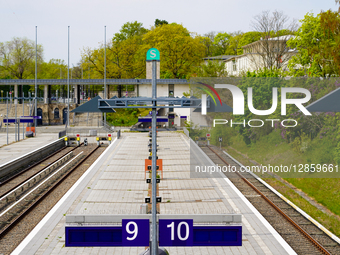
The Berlin Olympiastadion S-Bahn station in the Westend district of Berlin, Germany, serves regular suburban S-Bahn trains and special trains during major events at the nearby Olympic Stadium.
Restricted to Editorial Use Only.
Commercial use is not permitted without prior authorization.
Please contact us for more information.
#12859665
14 October 2025
The Berlin Olympiastadion S-Bahn station in the Westend district of Berlin, Germany, serves regular suburban S-Bahn trains and special trains during major events at the nearby Olympic Stadium.
Restricted to Editorial Use Only.
Commercial use is not permitted without prior authorization.
Please contact us for more information.
#12859670
14 October 2025
The Berlin Olympiastadion S-Bahn station in the Westend district of Berlin, Germany, serves regular suburban S-Bahn trains and special trains during major events at the nearby Olympic Stadium.
Restricted to Editorial Use Only.
Commercial use is not permitted without prior authorization.
Please contact us for more information.
#12859675
14 October 2025
The Berlin Olympiastadion S-Bahn station in the Westend district of Berlin, Germany, serves regular suburban S-Bahn trains and special trains during major events at the nearby Olympic Stadium.
Restricted to Editorial Use Only.
Commercial use is not permitted without prior authorization.
Please contact us for more information.
#12859680
14 October 2025
The Berlin Olympiastadion S-Bahn station in the Westend district of Berlin, Germany, serves regular suburban S-Bahn trains and special trains during major events at the nearby Olympic Stadium.
Restricted to Editorial Use Only.
Commercial use is not permitted without prior authorization.
Please contact us for more information.